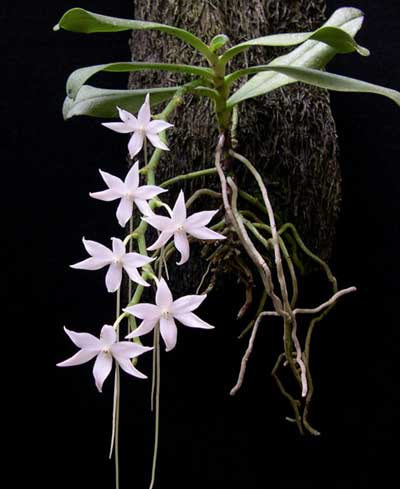
🌳 Description
-
Scientific name: Phalaenopsis honghenensis x floresensis
-
Family: Orchidaceae
-
Genus: Phalaenopsis
-
Origins: Horticultural cross between the two botanical species listed in the name.
-
Home use: Ornamental indoor orchid, to be placed near a bright window with filtered light. The position must be sheltered from cold drafts and away from direct heat sources.
-
Notable features: Hybrid obtained from the cross between Phalaenopsis honghenensis and Phalaenopsis floresensis. It combines two botanical species: flowering characteristics may vary from one specimen to another.
🌞 Light exposure
Prefer indirect, diffused light near a bright window. Shield from intense direct sunlight to prevent leaf scorch.
Observe the plant when the season changes: a suitable position in winter may receive too much sun in summer. Increase brightness gradually, avoiding sudden moves into full sun.
🚿 Watering
Water when the substrate is nearly dry and allow to drain completely. Do not use a fixed schedule: frequency depends on temperature, ventilation, and type of cultivation. Avoid waterlogging between the leaves and in the saucer.
Before watering, check the moisture level inside the container, not just on the surface. After watering, allow excess water to drain and empty the saucer.
🌡️ Minimum tolerable temperature and growing temperature
Avoid sudden fluctuations and cold drafts. As it is a cross between species, observe the plant's response to seasonal conditions and adjust watering and ventilation.
🌱 Soil type and repotting
Use an airy substrate for epiphytic orchids, based on bark or sphagnum managed without excess water. Repot when the material degrades, generally every 1–2 years, preferably during an active growth phase.
The container must allow drainage and not be disproportionate to the root system. During repotting, remove degraded material without damaging healthy roots.
🌿 Fertilization
During growth, use a diluted orchid fertilizer, periodically alternating with only water. Reduce inputs when growth slows down.
Do not increase the concentration to compensate for slow growth: light, temperature, and root health must be adequate before intensifying fertilization.
✂️ Pruning or other recommended agronomic treatments
Remove completely dry stems with clean tools. Keep healthy roots and leaves; avoid cutting still green parts unnecessarily.
💧 Ambient humidity
Maintain moderate ambient humidity and good ventilation, without leaving stagnant water in the heart of the plant.
The dimensions are purely indicative and are intended for an adult plant.